Pusoy Card Ranking Order: Build Stronger, Legal Hands
Game Overview
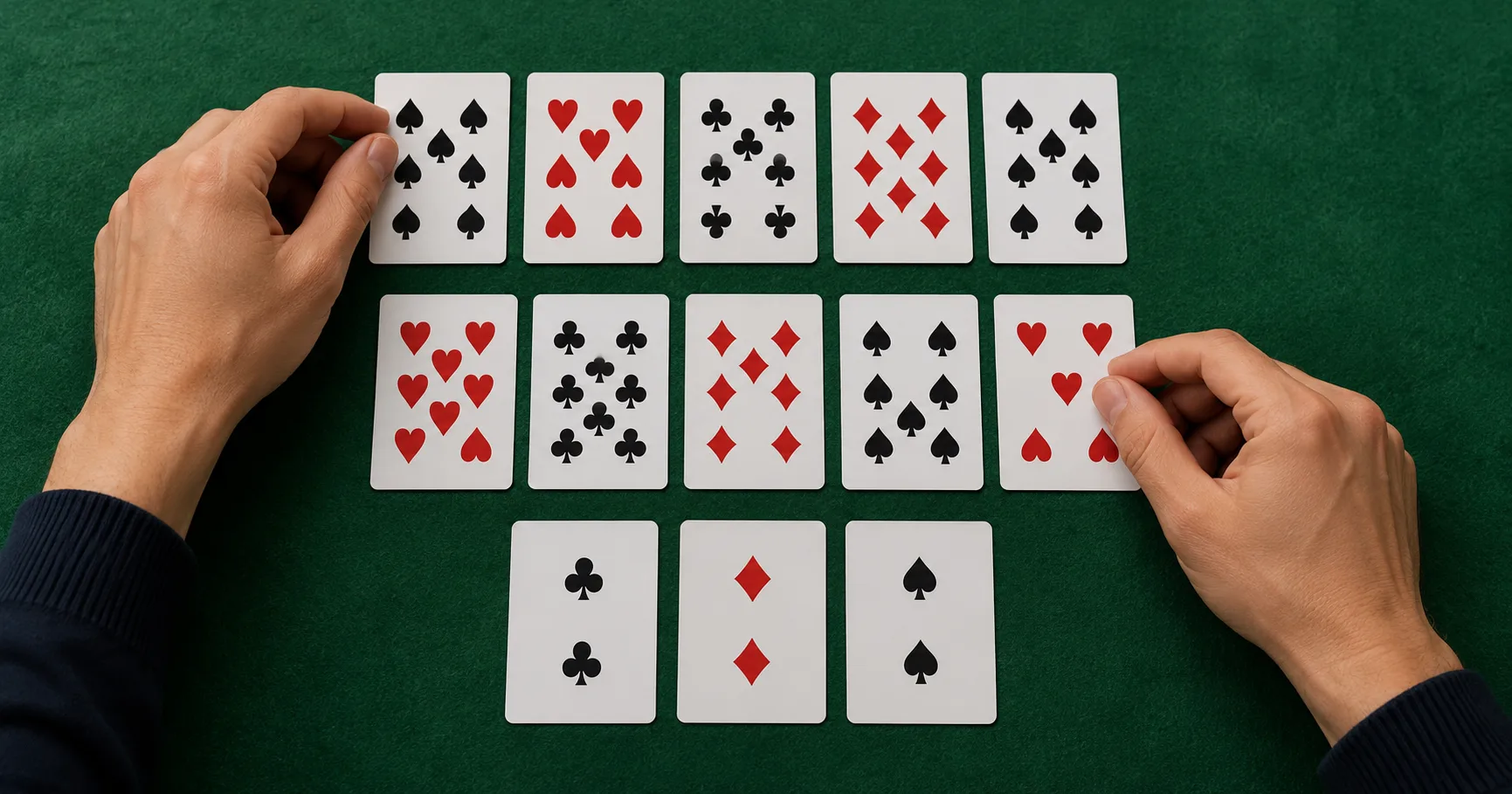
The pusoy card ranking order is useful only when you can turn it into a legal arrangement. In standard thirteen-card Pusoy, you divide your cards into a three-card front hand, a five-card middle hand, and a five-card back hand. The back must rank at least as high as the middle, while the middle must outrank the front under the table’s comparison rules.
Your challenge is to distribute strength across all three positions. Putting every useful card in the back can leave two weak hands. Building an ambitious front can create an illegal arrangement. Start with the ranking ladder, then compare complete layouts before committing. For the basic sequence of a round, see how to play Pusoy.
Check Which Pusoy Variant You Are Playing
This guide focuses on the thirteen-card arrangement game. Pusoy Dos uses a different objective: players take turns playing combinations to get rid of their cards. Its card and suit rules should not be carried into an arrangement game. If a table involves beating the previous play rather than setting three hands, consult Pusoy Dos rules and rankings.
Before joining, check how the table handles equal hands, special arrangements, royalties, and scoring across opponents. Those details affect which legal layout is preferable. A hand that earns an extra award under one ruleset may receive ordinary scoring elsewhere. Read the rules before using a strategy built around bonus points.
RTP + Volatility
Pusoy does not work like a slot with a single published return-to-player figure that describes every session. Your results depend on the cards, your arrangements, opponents’ decisions, scoring rules, and any fees. A percentage displayed beside a promotion or game listing should not be treated as the expected return from your own play.
For a useful cost comparison, check whether the platform charges per hand, takes a commission, or deducts another fee. Then examine how a round is settled. A displayed stake may not represent the maximum possible loss if the rules apply multipliers, special-hand payments, or separate settlements against several opponents.
Understand What Makes Results Swing
Here, volatility means how sharply your results can vary between rounds. Extra payments for sweeping all three positions or making qualifying hands can widen those swings. More opponents can also change your total exposure when each comparison is settled separately. Use the table’s settlement examples to calculate the possible loss before choosing a stake.
- Read the fee schedule and identify when charges apply.
- Check whether the stake is per round, opponent, or scoring unit.
- Review sweep payments, royalties, and special-hand settlements.
- Choose stakes that fit a fixed entertainment budget.
A strong arrangement improves your decisions; it does not remove the uncertainty of the deal. Avoid raising stakes to recover earlier losses. If the scoring system is difficult to explain in your own words, spend more time learning it before playing for money.
Symbol Guide: Cards and Hand Rankings
The relevant symbols in Pusoy are card ranks and suits. For ordinary poker-style comparisons, ranks descend from ace through king, queen, jack, ten, and the remaining numbered cards to two. An ace can also act low in an ace-to-five straight. Check the table’s straight and tie rules before assuming an unusual sequence or suit breaks a tie.
Five-Card Pusoy Card Ranking Order
Read this table from strongest to weakest for the standard five-card hierarchy used in the middle and back. A royal flush is the highest straight flush, rather than a separate type of combination with different comparison mechanics.
| Hand | What it contains | Example |
|---|---|---|
| Royal flush | Ace-high straight flush | Ten, jack, queen, king, ace of hearts |
| Straight flush | Five consecutive ranks in one suit | Five through nine of clubs |
| Four of a kind | Four cards of one rank | Four queens and a three |
| Full house | Three of one rank and two of another | Three eights and two kings |
| Flush | Five cards of one suit, without a consecutive sequence | Ace, jack, eight, six, two of diamonds |
| Straight | Five consecutive ranks, without all sharing one suit | Six, seven, eight, nine, ten in mixed suits |
| Three of a kind | Three cards of one rank | Three sevens with a king and four |
| Two pair | Two separate pairs | Two jacks, two fives, and a nine |
| One pair | Two cards of one rank | Two aces with a jack, eight, and three |
| High card | No stronger qualifying combination | Ace, jack, nine, six, three in mixed suits |
Front Hands and Tie Breaks
The three-card front ordinarily uses high card, one pair, or three of a kind. Three consecutive cards do not become a standard front-hand straight, and three matching suits do not become a standard flush. Check any special-hand rules separately from the ordinary front comparison.
Within a category, compare the defining ranks first. A pair of kings beats a pair of queens. For two pair, compare the higher pair, then the lower pair, then the remaining card. Full houses compare the triplet first. Kickers settle many otherwise equal hands, but front-to-middle comparisons need the table’s specific rules because the hands contain different numbers of cards.
Keep Pusoy hand ranking chart nearby while learning, and review Pusoy tie breaker rules before relying on suits or equal-ranked combinations.
Strategy Tips
Build Two Legal Arrangements Before Choosing
Start by identifying pairs, triplets, possible straights, and possible flushes. Make one obvious legal arrangement, then look for a second that spreads strength differently. Comparing complete layouts is more useful than admiring a single strong hand. Every card moved into one position must come from another.
- Group repeated ranks and identify five-card combinations.
- Set a back hand that can support a legal middle.
- Build the middle, then place the remaining three cards in front.
- Compare an alternative that strengthens a weaker position.
- Check the full order again before confirming.
Suppose your cards allow a flush in the back and two pair in the middle. That is a legal category order. Moving a card to improve the front may break the flush or remove one middle pair. Re-evaluate all three positions after the move; the strength of the original layout no longer applies.
Avoid Fouls Before Chasing Extra Points
A foul is an arrangement that violates the required hand order. Its exact penalty depends on the table, but preventing it should come before pursuing a speculative scoring advantage. A full house in the middle with only a flush in the back is out of order because a full house outranks a flush.
Use the final seconds of your turn to verify categories and relevant ranks. Do not depend entirely on an automatic arrangement feature: check what it selected and whether the rules explain its behavior. Practice with common Pusoy arrangement mistakes until spotting an inverted middle and back becomes routine.
Match Decisions to Scoring and Session Limits
When each position scores separately, consider the tradeoff between strengthening one position and weakening another. When extra payments apply, include their conditions in your comparison. Neither approach creates a universal best layout: the cards and scoring determine which choices deserve attention.
Practice arrangements without money where that option exists. For paid play, decide your spending limit and stopping time before the first round. Take a break when you begin rushing, repeatedly misreading ranks, or trying to win back losses. Review responsible play and session limits before increasing the pace or stakes.
Recommended Platforms: Compare the Pusoy Table First
Choose a platform by checking the actual game lobby and table rules. A familiar name or attractive promotion does not establish that it offers the Pusoy variant you want. Confirm the thirteen-card format, available practice options, turn timer, and settlement method before depositing.
For Lucky Fin Play, start with the current game listing and open the rules for the specific table you intend to join. Check the operator’s registered company name, account eligibility, fees, and withdrawal conditions on its own pages. Assess any other platform using the same steps so that your comparison reflects how you would actually play.
- Find a clear explanation of hand order, fouls, and tie handling.
- Review stakes alongside maximum settlement exposure.
- Check whether cards and final arrangements are easy to inspect.
- Read payment conditions and promotion terms separately.
Use Pusoy platform comparison to organize your checks. If a promotion interests you, read its eligible-game and wagering terms before opting in. Choose a table whose rules you understand and whose possible losses fit your budget; leave unclear offers until you can verify the conditions.