How pusoy dos combinations change the choice between card tables, slots and live games
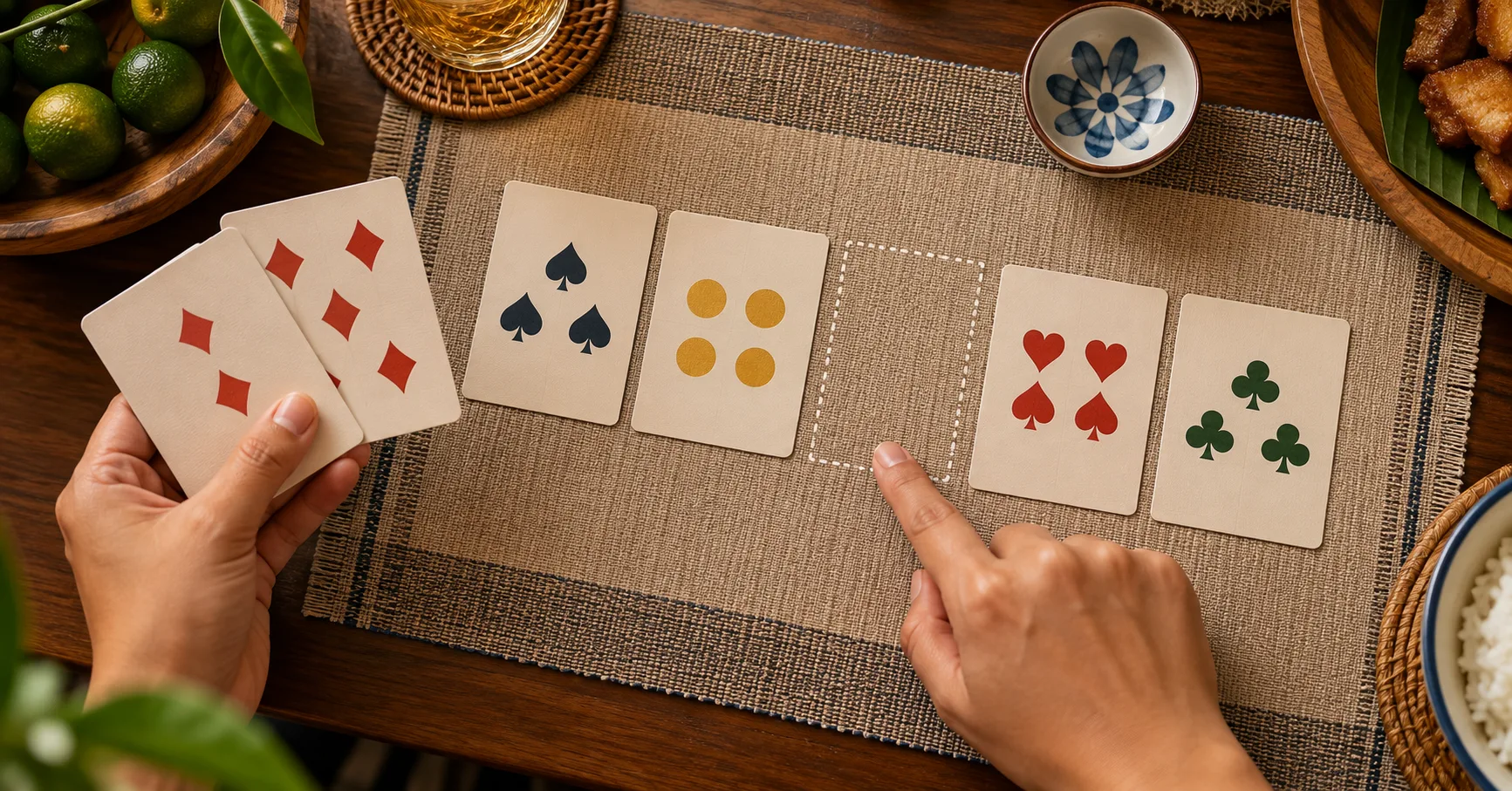
You are at home in the Philippines, switching between a card table on your phone and family messages while deciding how much uninterrupted play you actually have. Your GCash or Maya balance may cover a session, but available money does not make every game equally suitable. Pusoy dos combinations demand a particular kind of attention: each play changes what you can do with the cards left behind.
For an experienced player, the useful comparison goes beyond knowing which hand beats another. It concerns where decisions carry forward, how interruptions affect those decisions, and what a stake actually commits you to. Poker, slots and live casino games place those demands in different places. Choose around the decisions you enjoy making and the conditions you can sustain.
The combination you spend changes the hand you keep
Consider a hypothetical holding that includes 7♣, 7♦, 8♣, 9♣, 10♣ and J♣. Where the table accepts the corresponding five-card sequence, playing the pair of sevens breaks that option. Keeping the pair preserves a different route through your hand. Neither choice is automatically better without considering the lead, remaining opponents and accepted combinations.
This is the distinctive appeal of pusoy dos combinations. A legal play can still leave an awkward remainder. Experienced players assess both the cards entering the middle and the structure staying in their hand.
That differs from the attraction of a slot, where choosing a stake does not involve preserving cards for a later response. Poker also rewards connected decisions, but betting and incomplete information create a different problem. Familiarity with strong card patterns transfers only partway between these categories.
- Choose pusoy dos when you enjoy comparing two legal plays by the singles, pairs and five-card options each leaves behind.
- Choose poker when reading betting decisions and managing uncertain information interests you more than finding an efficient route through a dealt holding.
- Choose slots when you prefer a simpler decision structure, while setting a spending limit that does not depend on frequent wins.
- Choose live baccarat when choosing a betting outcome appeals more than managing cards, and you can follow the table's betting window.
- Choose live blackjack when decisions within a hand appeal to you, after checking the particular table's available actions and rules.
These distinctions describe participation, not expected profit. More decisions can make a game more engaging without making a particular session profitable. A player who enjoys control should distinguish meaningful choices from confidence about the result.
A familiar card pattern can carry an unfamiliar obligation
Your pusoy dos ranking knowledge is useful only when it matches the table you enter. Check suit order, accepted five-card hands, opening requirements and pass behaviour in the displayed rules. A remembered household rule can produce a costly misunderstanding when an app implements another convention.
The comparison with pusoy matters here because recognising poker-style combinations does not establish that two card games share the same objective. Evaluate what you must accomplish with the holding, rather than choosing by familiar card artwork. A familiar interface can conceal a different decision problem.
Settlement deserves the same attention as combinations. Before treating a displayed PHP 10 figure as your maximum exposure, identify whether it represents an entry amount, a unit of settlement or another charge. Read how the final result changes the amount paid.
- Read the opening rule and suit order before joining, especially when your usual home game uses a convention you remember automatically.
- Check whether passing affects your next opportunity to respond, because that rule changes the value of holding back a playable combination.
- Identify what the displayed peso amount purchases and whether settlement depends on remaining cards, multipliers or a fixed entry structure.
- Find the timeout and disconnection rules, including whether the system passes, selects an action or applies another consequence when time expires.
- Inspect any table charge separately from the advertised stake, then compare total exposure with the amount you planned for the session.
Those checks also improve comparisons with poker and live tables. A poker blind, a tournament entry and a baccarat wager describe different commitments. Matching the number on their buttons does not make their financial exposure equivalent.
Ten quiet minutes and thirty interrupted minutes are different resources
Imagine two weekend situations: 10 uninterrupted minutes after dinner, or 30 minutes while answering messages and helping with Christmas preparations. The longer window may offer less usable attention. Pusoy dos rewards remembering how the hand developed, not merely returning before your next button becomes available.
A missed sequence can leave you uncertain about which cards have appeared or why an opponent retained the lead. The problem persists after the connection recovers. Reopening the table restores the screen, but it does not automatically restore your understanding.
Poker can create a similar burden because betting history helps explain the current decision. A slot played one spin at a time requires less memory of an unfolding opponent contest. That can suit fragmented attention, although easier repetition also makes spending easier to overlook.
Live casino games impose another constraint: the betting window belongs to the table. A stream that looks smooth is not proof that a last-second action will arrive in time. Compare the category's timing demands with your connection and surroundings.
On mobile data, check the table's reconnection behaviour before committing money. If the app offers free practice, use it to assess readability and controls. Practice helps you evaluate handling; it does not establish how a paid table settles interruptions.
A PHP 300 comparison needs a common unit
Suppose you set aside PHP 300 purely for entertainment. This is a hypothetical budget, not a suggested deposit. Comparing categories becomes clearer when you measure committed money and remaining funds separately from the balance displayed after occasional wins.

At a hypothetical PHP 10 per spin, 30 spins create PHP 300 of turnover. That does not necessarily mean a PHP 300 loss, because returned amounts affect the balance. Reusing those returns can push turnover above the original budget.
A hypothetical PHP 30 fixed entry buys 10 entries from PHP 300 only when there are no additional charges or settlement obligations. A card table using variable settlement needs a different calculation. Check the maximum possible liability before comparing it with the fixed-entry example.
- Write down PHP 300 as the hypothetical session allocation, keeping transport money, meal money and other household spending outside that amount.
- For a PHP 10 spin example, track both completed spins and remaining balance, since turnover and net loss measure different things.
- For a PHP 30 entry example, confirm that the entry covers the full commitment before treating PHP 300 as ten attempts.
- For a variable-settlement card table, calculate exposure using its actual settlement rules instead of multiplying a small displayed amount by rounds.
- Keep any GCash or Maya top-up outside the original comparison, because adding funds changes the budget rather than improving the game's value.
This approach exposes a common selection mistake: preferring whichever game displays the smallest number. A low unit amount can accompany rapid repetition or a larger settlement obligation. Compare what you can lose under the actual rules and how quickly you can commit it.
Wallet convenience does not decide which game suits you
If a cashier lists GCash, Maya or a payment-centre route, inspect its instructions before transferring. Payment convenience is separate from game suitability. The same familiar wallet button does not make two tables equivalent in timing, exposure or decision quality.
When a transfer remains pending, resist switching categories merely because another screen appears ready to accept money. Check the wallet transaction record and cashier status before attempting another payment. Otherwise, a technical interruption can become an unplanned second allocation.
For players managing pusoy dos combinations, the strongest reason to choose the game is enjoying the trade-off between taking control and preserving a useful remainder. That preference is more durable than a convenient deposit route. It also gives you a clear reason to stop when distractions make that decision process frustrating.
Choose poker for its betting decisions, slots for their simpler participation, or a live table for its particular pace and actions. None removes the need for a spending boundary. Starting today, use your actual attention window, the table's complete rules and a fixed entertainment allocation to make the comparison concrete.